
General Questions About the Laos eVisa
What is the Laos eVisa?
The Laos eVisa is an electronic travel authorization that allows eligible foreign nationals to apply for a tourist visa online without visiting a Lao embassy or consulate. The entire application, payment, and approval process happens through the official Lao eVisa portal. Once approved, the eVisa approval letter is delivered by email and presented on arrival at any designated port of entry.
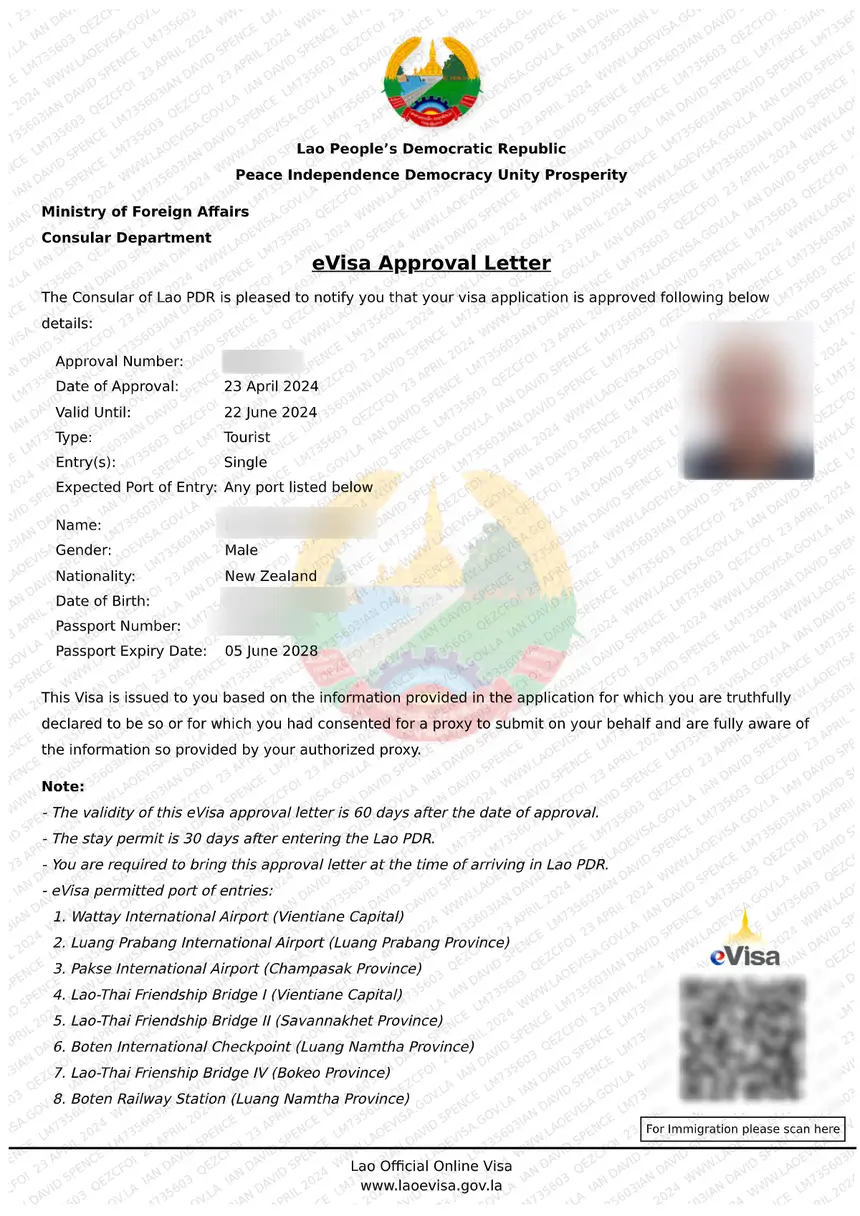
The eVisa falls under the T-B3 (Tourist) visa category. It is a single-entry visa valid for a stay of up to 30 days.
Who can apply for a Laos eVisa?
Nationals of over 100 countries are eligible to apply for a Laos eVisa. Eligibility depends on your passport nationality, not your country of residence. The full list of eligible nationalities is available on the official eVisa portal. If your nationality is not listed, you must apply through a Lao embassy or consulate or obtain a Visa on Arrival.
What is the difference between a Laos eVisa and a Visa on Arrival?
The main differences are the application process, cost, and time spent at the border:
| Feature | eVisa | Visa on Arrival |
|---|---|---|
| Application | Online, before travel | At the airport or land border |
| Processing time | 3-5 working days | 15-30 minutes at the border |
| Cost | ~$50 USD | ~$42 USD + processing fee |
| Queue at border | Dedicated eVisa counter (faster) | Standard queue |
| Eligible entry points | Designated airports and land borders | All official entry points |
For a full comparison, see our eVisa vs Visa on Arrival guide.
Is the Laos eVisa the same as a tourist visa?
Yes. The Laos eVisa is specifically the T-B3 Tourist Visa issued electronically. It grants the same permissions as a tourist visa obtained at an embassy or on arrival – you can enter Laos for tourism purposes and stay for up to 30 days. For details on all visa types, including business and transit visas, see our dedicated pages.
Can I use the eVisa for business travel in Laos?
No. The eVisa is strictly for tourism purposes only (T-B3 category). If you are travelling for business, meetings, conferences, or any form of employment, you need a business visa (NI-B2 category). Business visas must be obtained at a Lao embassy or consulate – they are not available as an eVisa or on arrival.
Application Process
How do I apply for a Laos eVisa?
The application is made entirely online through the official portal. The basic steps are:
- Visit the official Lao eVisa website (laoevisa.gov.la)
- Create an account or log in
- Fill in personal details, passport information, and travel dates
- Upload the required documents (passport scan and photograph)
- Pay the visa fee by credit or debit card
- Wait for processing (3-5 working days)
- Receive the approval letter by email
- Print the approval letter and present it on arrival
For a detailed walkthrough, see our How to Apply for a Laos eVisa guide.
What documents do I need for the application?
You need the following documents ready in digital format before starting your application:
- Passport bio page scan (JPG, PNG, or PDF, max 2 MB)
- Passport-style photograph (JPG or PNG, 4×6 cm, white background)
- Travel itinerary or flight booking (recommended)
- Hotel reservation (recommended)
A complete checklist with specifications is available on our Laos eVisa Documents page.
What are the photo requirements?
The photograph must meet these specifications:
| Requirement | Specification |
|---|---|
| Size | 4 cm x 6 cm |
| Background | Plain white |
| Format | JPG or PNG |
| Colour | Full colour only |
| Recency | Taken within the last 6 months |
| Expression | Neutral, eyes open, mouth closed |
Non-compliant photos are one of the most common reasons for application rejection. See our Laos eVisa Photo Requirements page for detailed guidance and common mistakes.
How long does it take to process a Laos eVisa?
Standard processing takes 3 to 5 working days from the date of application. Processing times may be longer during peak travel seasons (November to February) and Lao public holidays. It is recommended to apply at least 2 weeks before your intended travel date.
For more detail, see our Laos eVisa Processing Time guide.
Can I expedite the eVisa processing?
No. There is no expedited or priority processing option available for the Laos eVisa. All applications follow the same processing timeline. If you need a visa urgently, you may be able to obtain a Visa on Arrival at the airport, which takes 15-30 minutes at the border.
How much does the Laos eVisa cost?
The standard Laos eVisa fee is approximately $50 USD for most nationalities. The fee is paid online by credit or debit card during the application process. Some nationalities may have slightly different fees. For a detailed breakdown, see our Laos eVisa Fee page.
Can I pay for the eVisa in cash?
No. The eVisa fee must be paid online by credit or debit card (Visa, Mastercard, or JCB) during the application process. Cash payments are not accepted for eVisa applications. If you prefer to pay in cash, you can obtain a Visa on Arrival at the border instead.
Validity and Duration
How long is the Laos eVisa valid?
The eVisa approval letter is valid for 60 days from the date of issuance. You must enter Laos within this 60-day validity window. If you do not enter within 60 days, the eVisa expires and you must apply again (and pay the fee again).
How long can I stay in Laos with an eVisa?
The eVisa allows a single stay of up to 30 days from the date of entry. The exact permitted stay is stamped in your passport by the immigration officer at the port of entry.
Can I extend my stay beyond 30 days?
Yes. A 30-day tourist eVisa can be extended once for an additional 30 days at the Immigration Department office in Vientiane. The extension costs approximately $2 USD per day. You must apply for the extension before your current visa expires. For more information, see our Laos Visa Extension guide.
Can I enter Laos multiple times with one eVisa?
No. The eVisa is a single-entry visa. Once you leave Laos, the eVisa is no longer valid. If you plan to leave and re-enter Laos (for example, visiting Thailand or Vietnam and returning), you will need to apply for a new eVisa or obtain a new Visa on Arrival.
What happens if I overstay my visa?
Overstaying your visa in Laos is a serious offence. Penalties include:
- Fine: Approximately $10 USD per day of overstay
- Detention: You may be detained by immigration authorities
- Deportation: In severe cases, deportation and a ban on re-entry
- Exit complications: You will not be allowed to leave the country without paying all fines
Always check the expiry date stamped in your passport and plan your departure accordingly.
Entry and Arrival
Which entry points accept the Laos eVisa?
The eVisa is accepted at the following major entry points:
Airports:
– Wattay International Airport (Vientiane)
– Luang Prabang International Airport
– Pakse International Airport
Land borders:
– Thai-Lao Friendship Bridge I (Vientiane – Nong Khai)
– Thai-Lao Friendship Bridge II (Savannakhet – Mukdahan)
– Thai-Lao Friendship Bridge III (Thakhek – Nakhon Phanom)
– Thai-Lao Friendship Bridge IV (Huay Xai – Chiang Khong)
Not all land border checkpoints accept eVisa. For a full list of land border crossings that accept eVisa, see our dedicated page.
What do I need to present at the border?
When you arrive at a Lao port of entry, present the following to the immigration officer:
- Printed eVisa approval letter (digital copies on phone may not be accepted)
- Valid passport (the same one used in the application)
- Completed arrival/departure card (provided on the plane or at the counter)
- LDIF digital arrival form confirmation (must be completed online before arrival)
What is the LDIF form?
The LDIF (Laos Digital Immigration Form) is a new electronic arrival card that all visitors must complete online at least 3 days before arrival in Laos. It replaces the traditional paper arrival card. The form collects your personal details, flight information, accommodation, and purpose of visit. You must complete the LDIF form in addition to having a valid visa.
Do I need a return ticket to enter Laos?
While not always strictly enforced, immigration officers may ask for proof of onward travel. It is strongly recommended to have:
- A return flight ticket, or
- A confirmed booking for travel to your next destination
This is especially important for travellers with a 30-day eVisa, as you need to demonstrate you will leave Laos before your visa expires.
Do I need travel insurance for Laos?
Travel insurance is not a mandatory requirement for the eVisa application, but it is strongly recommended. Laos has limited medical facilities, especially outside Vientiane. In the event of a medical emergency, evacuation to Thailand may be necessary, which can be extremely expensive.
Status and Troubleshooting
How do I check my eVisa application status?
You can check your application status by logging into your account on the official Lao eVisa portal (laoevisa.gov.la). The status will show as one of the following:
- Submitted – Application received, awaiting review
- Processing – Under review by immigration authorities
- Approved – eVisa granted, approval letter available for download
- Rejected – Application denied (reasons provided)
For a step-by-step guide, see our Laos eVisa Status Check page.
My eVisa was rejected. What can I do?
The most common reasons for rejection include:
- Incorrect or unclear passport scan – blurry, cropped, or low-resolution images
- Non-compliant photo – wrong size, background colour, or wearing glasses
- Passport validity – less than 6 months remaining
- Incorrect personal details – name, date of birth, or passport number mismatch
- Previous overstay – history of overstaying in Laos
If your application is rejected, you can:
- Reapply – Correct the issues and submit a new application (new fee required)
- Apply for Visa on Arrival – Obtain a visa at the border instead
- Contact the Lao embassy – For complex cases
For a detailed breakdown, see our Laos eVisa Rejected guide.
Can I get a refund if my eVisa is rejected?
No. The eVisa fee is non-refundable, regardless of the outcome of your application. If your application is rejected, you must pay the full fee again when reapplying.
Can I change my travel dates after the eVisa is issued?
No. Once the eVisa is issued, you cannot modify the travel dates, passport details, or any other information. If your plans change significantly, you may need to apply for a new eVisa. Minor date changes (within the 60-day validity window) are generally fine, as long as you enter Laos before the eVisa expires.
My passport has been renewed since I applied. Can I still use the eVisa?
No. The eVisa is linked to the specific passport used in the application. If you renew your passport, your eVisa is no longer valid. You must apply for a new eVisa with your new passport.
Nationality-Specific Questions
Do US citizens need a visa for Laos?
Yes. US citizens need a visa to enter Laos. They can apply for an eVisa online, obtain a Visa on Arrival at the border, or apply at a Lao embassy. The eVisa is the most convenient option for tourism.
Do UK citizens need a visa for Laos?
Yes. UK citizens need a visa to enter Laos. They are eligible for the eVisa, Visa on Arrival, or embassy application. For specific details, see our Laos eVisa UK Citizens page.
Do Indian citizens need a visa for Laos?
Yes. Indian citizens need a visa to enter Laos. They can apply for an eVisa online or obtain a Visa on Arrival at the border. The eVisa fee and requirements are the same as for most other nationalities.
Do Pakistani citizens need a visa for Laos?
Yes. Pakistani citizens need a visa to enter Laos. They can apply for an eVisa online. However, additional documentation may be required, and processing times may be longer. Pakistani passport holders should apply well in advance.
Do Chinese citizens need a visa for Laos?
Yes. Chinese citizens need a visa to enter Laos. They can apply for an eVisa online or obtain a Visa on Arrival at the border. See our Laos eVisa Chinese Citizens page for specific guidance.
Are there any countries whose citizens don’t need a visa for Laos?
Yes. Citizens of several ASEAN nations and a few other countries are exempt from visa requirements for short stays. The visa exemption list includes countries like Thailand, Vietnam, Cambodia, Malaysia, Singapore, Indonesia, the Philippines, and others. Exempt stays are typically 14-30 days depending on nationality.
Practical Questions
Can I work in Laos with a tourist eVisa?
No. The tourist eVisa does not permit any form of employment or paid work in Laos. Working on a tourist visa is illegal and can result in fines, detention, and deportation. If you plan to work in Laos, you need a business visa or work permit.
Do I need the LDIF form if I have an eVisa?
Yes. The LDIF (Laos Digital Immigration Form) is a separate requirement from the visa. All visitors, including eVisa holders, must complete the LDIF form online at least 3 days before arrival. Having an approved eVisa does not exempt you from the LDIF requirement.
Can I travel to other provinces in Laos with an eVisa?
Yes. Once you have entered Laos with an eVisa, you can travel freely within the country. There are no internal travel restrictions for tourist visa holders. However, some remote border areas may require additional permits from local authorities.
What currency should I bring to Laos?
The official currency is the Lao Kip (LAK), but Thai Baht and US Dollars are widely accepted in tourist areas. ATMs are available in major cities (Vientiane, Luang Prabang, Vang Vieng, Pakse) but may be scarce in rural areas. Credit cards are accepted at larger hotels and restaurants but not at smaller establishments.
Is Laos safe for tourists?
Laos is generally a safe destination for tourists. Petty crime such as bag snatching and pickpocketing can occur in tourist areas, particularly in Vientiane and Luang Prabang. Take standard precautions:
- Keep valuables in a hotel safe
- Avoid walking alone at night in unfamiliar areas
- Be cautious with tuk-tuk drivers and unofficial guides
- Carry copies of your passport and eVisa, not the originals
What should I know about Lao customs and etiquette?
Lao culture is deeply influenced by Theravada Buddhism. Key points for visitors:
- Dress modestly when visiting temples (cover shoulders and knees)
- Remove shoes before entering temples and homes
- Do not touch monks, especially if you are female
- Do not point your feet at people or Buddha images
- Ask permission before photographing people, especially monks and rural villagers
Summary
This FAQ covers the most common questions about the Laos eVisa. For more detailed information on specific topics, explore our other guides:
- Laos eVisa Complete Guide – Full overview of the eVisa process
- How to Apply for a Laos eVisa – Step-by-step application guide
- Laos eVisa Fee – Detailed fee breakdown by nationality
- Laos eVisa Processing Time – What to expect during processing
- Laos eVisa Status Check – How to track your application
- Laos eVisa Rejected – Common rejection reasons and solutions
- Laos eVisa Documents – Complete document checklist
- Laos Visa Types – All visa categories explained
- Laos Entry Requirements – Everything you need to enter Laos