
Planning a trip to Laos but unsure whether to apply for an eVisa or go through the embassy? This is a common question, especially for travelers who need more than a standard tourist visa or who are not eligible for the online system.
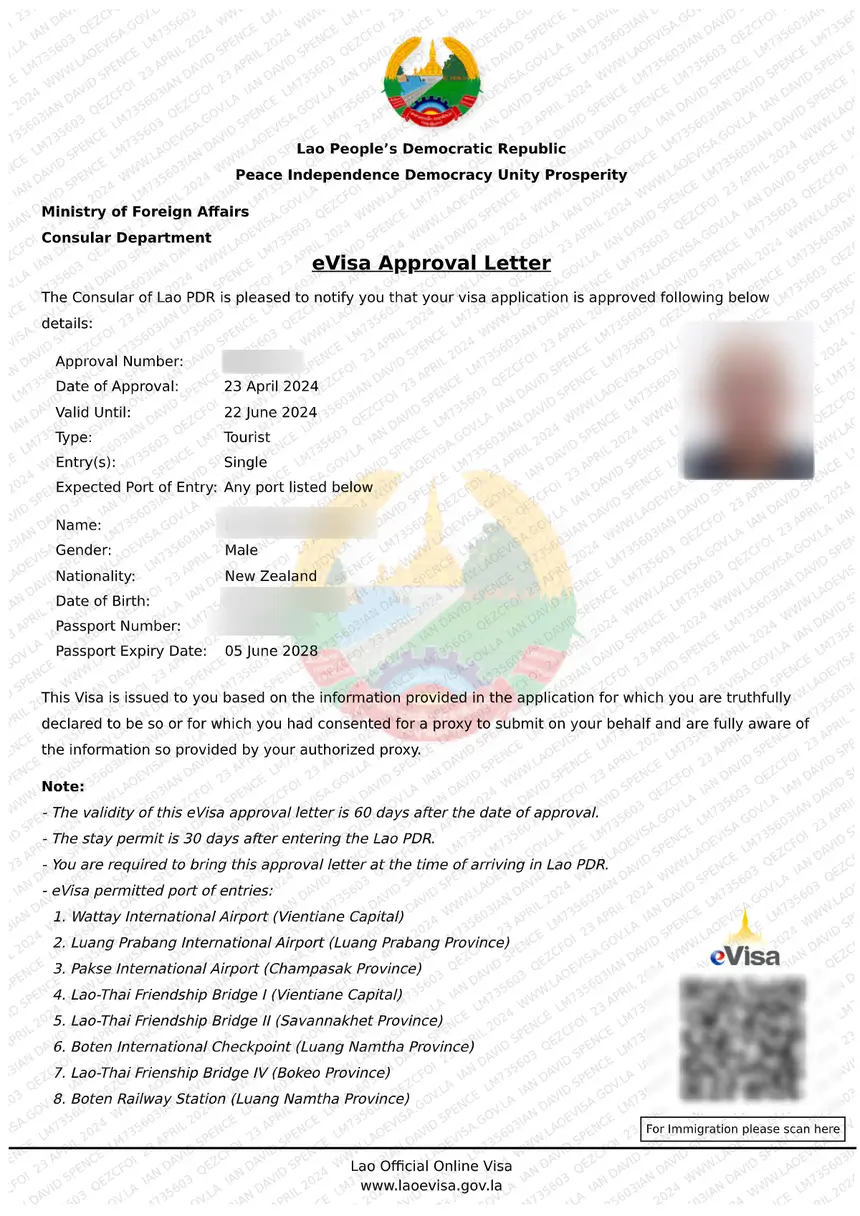
This guide compares the Laos eVisa and embassy visa side by side so you can decide which route makes sense for your trip.
Quick Comparison: eVisa vs Embassy Visa at a Glance
| Feature | eVisa | Embassy Visa |
|---|---|---|
| Cost | ~$50 USD (all-inclusive) | Varies by visa type and nationality |
| Application | Online at laoevisa.gov.la | In person at a Laos embassy or consulate |
| Processing | 3-5 working days | 5-10 working days (varies by embassy) |
| Stay Duration | 30 days | 30-90 days depending on visa type |
| Validity | 60 days from issuance | As issued by the embassy |
| Entry Type | Single entry | Single or multiple entry available |
| Visa Categories | Tourist (T-B3) only | All categories (tourist, business, transit, diplomatic, etc.) |
| Payment | Credit/debit card online | Cash or bank transfer (varies by embassy) |
| Documents | Passport scan + digital photo | Passport, photos, application form, invitation letter (for some types) |
| Best For | Short tourist trips | Business, long stays, multiple entries, nationalities not eligible for eVisa |
What Is the Laos eVisa?
The Laos eVisa is an electronic visa available through the official government portal at laoevisa.gov.la. It was introduced to streamline the tourist visa process and reduce wait times at arrival ports.
Key features of the eVisa:
- 100% online application – No need to visit an embassy or mail your passport
- Tourist visa only – The eVisa is issued under the T-B3 category. You cannot use it for business, work, or other purposes
- 30-day stay – You can stay in Laos for up to 30 days from your date of entry
- Single entry – Once you leave Laos, the eVisa is used up. You would need a new visa to re-enter
- Dedicated lane – eVisa holders get access to a special immigration lane at supported entry points, which is typically much shorter than the standard queue
- Digital payment – You pay by credit or debit card during the online application. No cash needed at the border
The eVisa is the simplest option for tourists who know their travel dates and are entering through a major airport or supported land border crossing.
What Is the Laos Embassy Visa?
An embassy visa is the traditional way to obtain a Laos visa. You apply in person (or by mail in some cases) at a Lao embassy or consulate in your home country or a country where you have legal residence.
Here is how the embassy visa works:
- In-person application – You visit the nearest Lao embassy or consulate with your documents. Some embassies accept applications by mail
- All visa categories – The embassy can issue any visa type: tourist (T-B3), business (NI-B2), transit (TR-B3), diplomatic (D-A1), official (S-A2), labour (LA-B2), and more
- Flexible duration – Depending on the visa type, you can get a stay of 30, 60, or even 90 days. Some visa types allow longer stays with sponsorship
- Single or multiple entry – Unlike the eVisa, the embassy can issue multiple-entry visas, which are useful if you plan to cross in and out of Laos during your trip
- Requires more paperwork – You typically need a completed application form, passport-sized photos, your original passport, and sometimes an invitation letter or supporting documents from a Laos-based organization
The embassy route takes more time and effort, but it is the only option if you need a visa category other than tourist or if your nationality is not eligible for the eVisa.
Cost Comparison
eVisa Cost
The eVisa costs approximately $50 USD all-inclusive. This covers the government visa fee and the online processing fee. You pay by card during the application, and there are no additional charges when you arrive in Laos.
Embassy Visa Cost
Embassy visa fees vary depending on the visa type and the specific embassy. As a general guide:
| Visa Type | Approximate Fee |
|---|---|
| Tourist (T-B3) | $30-50 USD |
| Business (NI-B2) | $40-60 USD |
| Transit (TR-B3) | $20-30 USD |
| Multiple-entry (any type) | $50-80 USD |
Some embassies charge additional service or processing fees. You may also pay for return postage if applying by mail. The exact fee depends on the embassy – some charge more than others for the same visa type.
Bottom line: For a standard tourist visa, the eVisa and embassy visa cost about the same. For business or multiple-entry visas, the embassy is your only option regardless of price.
Processing Time
eVisa Processing
The eVisa takes 3-5 working days to process. You apply online, upload your documents, pay by card, and receive an approval letter by email. Apply at least one week before your trip to be safe.
Embassy Visa Processing
Embassy processing typically takes 5-10 working days, but this varies significantly by embassy location. Some embassies offer expedited processing for an additional fee, which can reduce the wait to 2-3 days. Others may take longer if they need to forward your application to Vientiane for approval.
If you are applying by mail, add shipping time in both directions. The total process can take 2-3 weeks.
For urgent travel: If you need a visa within a few days and are not eligible for the eVisa, contact the nearest embassy directly. Some can process visas faster in emergencies, though this is not guaranteed.
Visa Categories and Flexibility
This is where the embassy visa has a clear advantage. The eVisa is limited to the T-B3 tourist category – nothing else. The embassy can issue all 13 visa categories recognized by the Laos government.
When You Must Use the Embassy
You cannot use the eVisa if you are traveling to Laos for:
- Business (NI-B2) – meetings, conferences, commercial activities, or employment
- Work (LA-B2) – any form of paid employment requires a labour visa obtained through the embassy with employer sponsorship
- Transit (TR-B3) – passing through Laos to another country for up to 5 days
- Diplomatic or official travel (D-A1, S-A2) – government officials and diplomats
- Multiple entries – if you plan to leave and re-enter Laos during your trip
- Stays longer than 30 days – the eVisa is capped at 30 days with no category that allows more
For any of these situations, the embassy is your only route.
Entry Points
eVisa Entry Points
The eVisa is accepted at:
- Wattay International Airport (Vientiane)
- Luang Prabang International Airport
- Pakse International Airport
- Select land border crossings including the Friendship Bridge at Vientiane and several Thai-Laos crossings
Not all land border crossings accept the eVisa. If you are entering Laos at a smaller or less common crossing, the eVisa may not work and you would need to get a visa on arrival or use an embassy visa instead.
Embassy Visa Entry Points
An embassy visa is accepted at all entry points – every international airport, every land border crossing, and every river port. This gives you maximum flexibility if you are entering Laos through a less common route.
Application Process
Applying for an eVisa
The eVisa application is straightforward:
- Go to laoevisa.gov.la
- Create an account and fill in the online form
- Upload a passport scan and a digital photo (4×6 cm, color, white background)
- Pay by credit or debit card (~$50 USD)
- Wait 3-5 working days for the approval email
- Print the approval letter and carry it with your passport
For a step-by-step walkthrough, see our guide on how to apply for a Laos eVisa.
Applying for an Embassy Visa
The embassy application involves more steps:
- Find your nearest Lao embassy or consulate
- Check the embassy website or call for specific requirements (they vary)
- Prepare your documents: passport, photos, completed application form, and any supporting documents (invitation letter for business visas, employer letter for work visas)
- Submit your application in person or by mail
- Pay the visa fee (cash or bank transfer, depending on the embassy)
- Wait 5-10 working days for processing
- Collect your passport with the visa stamp
Some embassies require you to pick up in person; others mail the passport back to you.
Which Should You Choose?
Choose the eVisa If:
- You are a tourist visiting Laos for up to 30 days
- You want the simplest, fastest application process
- You prefer paying by card online
- You are entering through a major airport or supported border crossing
- You want your visa approved before you travel (no surprises at the border)
- You want to use the dedicated eVisa lane at immigration
Choose the Embassy Visa If:
- You need a business, work, transit, or diplomatic visa
- You plan to stay in Laos longer than 30 days
- You need a multiple-entry visa
- Your nationality is not eligible for the Laos eVisa
- You are entering Laos through a border crossing that does not accept eVisa
- You need the visa stamped in your passport before travel for onward visa applications to other countries
The Verdict
For most tourists with a planned itinerary, the eVisa is the clear winner. It is faster, simpler, and gives you a dedicated immigration lane. The online application takes 10-15 minutes, and you get your approval within days.
The embassy visa is the right choice when you need more than a standard tourist visa – business travel, work permits, long stays, or multiple entries. It takes more effort but gives you access to visa categories the eVisa simply does not offer.
If you are eligible for both, ask yourself one question: Am I traveling as a tourist for 30 days or less? If yes, go with the eVisa. If no, the embassy is your path.
Frequently Asked Questions
Can I apply for both the eVisa and an embassy visa?
No. You should only apply through one channel. If you have a valid eVisa, you do not need an embassy visa, and vice versa. Applying for both can cause confusion at immigration.
Is the eVisa accepted at all Laos border crossings?
No. The eVisa is accepted at major international airports (Wattay, Luang Prabang, Pakse) and select land border crossings. Smaller crossings may only offer visa on arrival or require an embassy visa. Check the list of eVisa entry points before you travel.
What if my nationality is not eligible for the eVisa?
If your nationality is not on the eVisa eligibility list, you must apply through a Lao embassy or consulate, or get a visa on arrival at the border (if your nationality qualifies for VOA). See our visa requirements guide for details.
Can I get a business visa through the eVisa system?
No. The eVisa system only issues tourist visas (T-B3 category). For a business visa (NI-B2), you must apply at a Lao embassy. You will typically need an invitation letter from a Laos-based company or organization.
How long does an embassy visa take to process?
Processing times vary by embassy but typically range from 5-10 working days. Some embassies offer expedited processing for an additional fee. If applying by mail, add shipping time in both directions.
Can I extend an eVisa or embassy visa in Laos?
Yes. Both the eVisa and embassy tourist visa can be extended once at the immigration office in Vientiane. The extension is typically for an additional 30 days and costs around $2 per day plus a small processing fee. Business and work visas may have different extension rules depending on the sponsoring organization.
Do I need to print the eVisa approval?
Yes. You should print a copy of your eVisa approval letter and carry it with your passport when traveling. Digital copies on your phone may not be accepted at all immigration counters.
Is the embassy visa stamped in my passport?
Yes. The embassy visa is a physical stamp or sticker placed in your passport. This can be useful if you need to show proof of a valid visa for onward travel to other countries that require it.