
What Is a Laos Transit Visa?
A Laos transit visa (category TR-B3) is a short-stay visa that lets travelers pass through Laos on their way to another country, with a maximum stay of five days. It is designed for people who need to enter Laos briefly before continuing their journey – not for tourism or long-term stays. The transit visa is single-entry only and does not allow employment, study, or business activities.
If you are simply changing planes at a Lao airport without passing through immigration, you do not need a transit visa. The visa becomes necessary when you plan to leave the airport or enter Laos overland as part of an onward journey.
Understanding your visa options is important before traveling. For a broader overview of all available visa categories, see our guide to Laos visa types.
Who Needs a Laos Transit Visa?
You need a transit visa if all of the following apply:
- You plan to enter Laos (not just pass through an airport transit zone)
- Your stay will be longer than a few hours but no more than five days
- You are travelling through Laos to reach another country
- Your nationality does not qualify for visa-free entry
Who Is Exempt?
You do not need a transit visa if:
- You remain inside the international transit area at the airport and do not pass through immigration
- Your nationality qualifies for visa-free entry to Laos and your stay falls within the permitted period (typically 30 days for ASEAN nationals)
- You already hold a valid Laos tourist visa or eVisa
Children of all ages need their own transit visa when entering Laos, even if they are travelling on a parent’s passport or listed in it.
Laos Transit Visa Requirements
To apply for a transit visa, you need the following documents:
| Requirement | Details |
|---|---|
| Valid passport | At least 6 months validity from date of entry, with at least one blank page |
| Passport-size photo | Recent colour photo, 4×6 cm, white background |
| Completed application form | Available at Lao embassies or at the port of entry |
| Confirmed onward travel | Flight, bus, or train ticket to a third country showing departure within 5 days |
| Visa for next destination | If your destination country requires one, have it ready |
| Visa fee | Paid in cash (USD) at the port of entry or at a Lao embassy |
The six-month passport validity rule is strictly enforced. If your passport expires within six months of your entry date, immigration officers may deny you entry even if you have a valid visa.
How to Apply for a Laos Transit Visa
There are two ways to obtain a transit visa:
Option 1: Apply at a Lao Embassy or Consulate
- Visit the nearest Lao embassy or consulate with your documents
- Complete the visa application form
- Submit your passport, photos, and onward travel proof
- Pay the visa fee
- Wait for processing (typically 3 working days)
- Collect your passport with the visa stamp
Applying in advance is the safest option, especially during peak travel season when embassy processing may take longer.
Option 2: Visa on Arrival at the Border
You can obtain a transit visa at certain Lao ports of entry:
| Entry Point | Location |
|---|---|
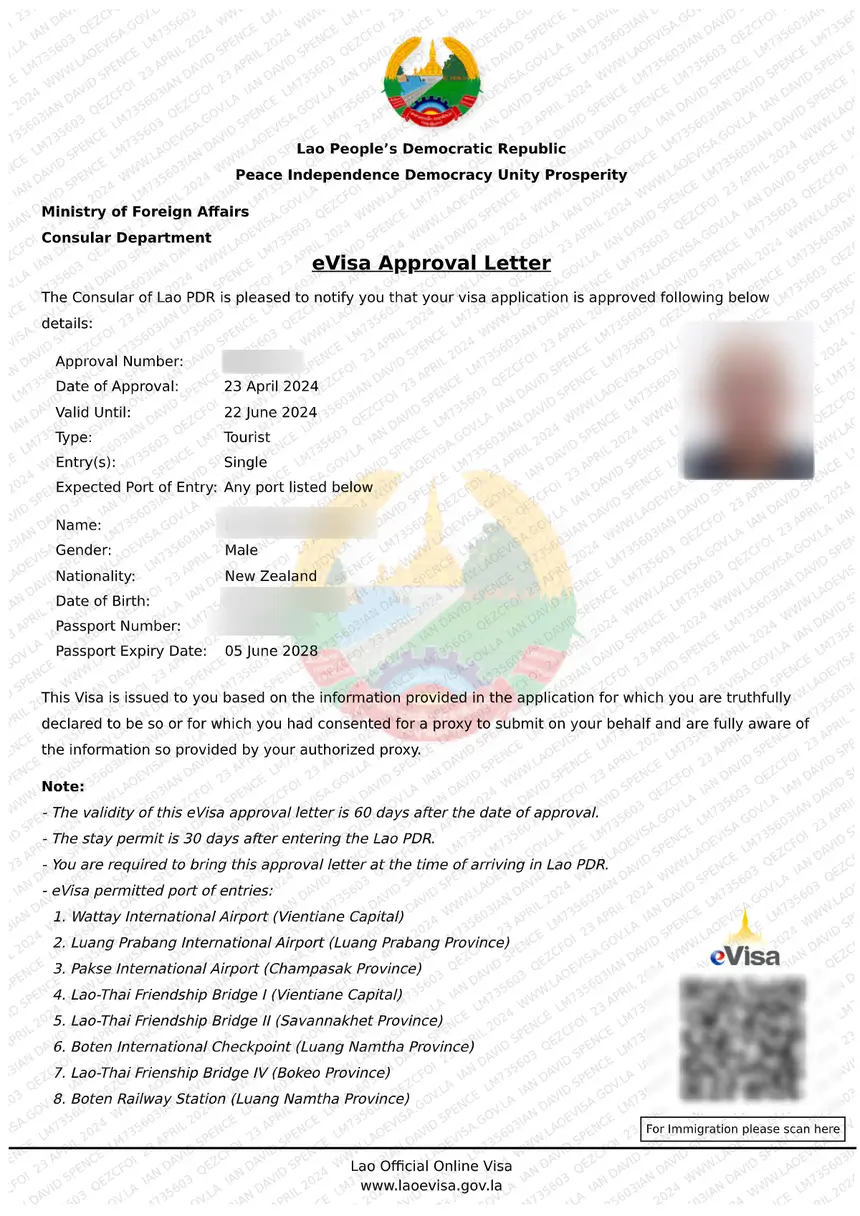
| Wattay International Airport | Vientiane Capital |
| Luang Prabang International Airport | Luang Prabang |
| Pakse International Airport | Champasack Province |
| Friendship Bridge I | Vientiane Capital (Nong Khai – Vientiane) |
| Friendship Bridge II | Savannakhet Province |
| Friendship Bridge IV | Bokeo Province |
| Boten International Checkpoint | Luang Namtha Province |
Important: Visa on arrival counters at airports and land borders typically issue tourist visas (T-B3), not transit visas (TR-B3). If you specifically need a transit visa, it is safer to apply at a Lao embassy before your trip. Confirm with the specific port of entry or your nearest Lao consulate before relying on a visa on arrival for transit purposes.
For detailed information about getting visas at airports, see our Laos visa on arrival guide.
Laos Transit Visa Fee
The transit visa fee depends on your nationality. Fees must be paid in cash (US dollars) at the port of entry, or at a Lao embassy in local currency or USD.
| Nationality Group | Approximate Fee (USD) |
|---|---|
| ASEAN nationals | $20 – $30 |
| Most nationalities | $30 – $42 |
| US citizens | $42 |
| UK citizens | $35 – $42 |
Fees may vary slightly by entry point and are subject to change. Always bring small denomination USD bills ($1, $5, $10, $20) as change is often not available at border crossings.
Note that the transit visa fee is typically lower than the Laos eVisa fee, which costs around $50 for the standard tourist visa.
What You Can and Cannot Do on a Transit Visa
A transit visa is strictly for passing through Laos. Here is what you can and cannot do:
Permitted activities:
- Transit through Laos to your final destination
- Brief sightseeing or rest during the 5-day period
- Stay in hotels, guesthouses, or other accommodation
- Visit friends or family for personal, non-commercial purposes
Restricted activities:
- Employment or paid work of any kind
- Business meetings, conferences, or commercial activities
- Enrolment in academic or training programmes
- Volunteer work
- Staying beyond the 5-day limit
Penalties for Overstaying
Overstaying a transit visa is taken seriously in Laos. Penalties include:
- A fine of approximately $10 per day of overstay
- Possible detention while the overstay is processed
- Deportation at your own expense
- A potential ban on re-entering Laos in the future
If you realise you cannot leave Laos within the 5-day limit, visit the nearest immigration office before your visa expires. You may be able to apply for an extension or change your visa status, though this is not guaranteed.
Laos Transit Visa vs Tourist Visa: Which Do You Need?
If your plans go beyond simply passing through Laos, a tourist visa may be more appropriate. The Laos eVisa is available online for tourist visits and offers a 30-day stay, which gives you much more flexibility.
| Feature | Transit Visa (TR-B3) | Tourist Visa (T-B3) |
|---|---|---|
| Maximum stay | 5 days | 30 days |
| Entry type | Single entry | Single entry |
| Available online (eVisa) | No | Yes |
| Available at border | Limited (embassy recommended) | Yes |
| Extension possible | Difficult | Yes, once for 30 more days |
| Typical fee | $20 – $42 | $42 – $50 |
| Purpose | Transit only | Tourism and leisure |
For most travelers, the tourist visa or eVisa is the better option unless you specifically need the shorter duration and lower cost of a transit visa. If your nationality is eligible, you can apply for the Laos eVisa online in advance.
FAQs About Laos Transit Visa
Can I get a Laos transit visa on arrival?
Transit visas are primarily issued at Lao embassies and consulates before travel. Visa on arrival counters at airports and borders typically issue tourist visas instead. Contact the specific port of entry or your nearest Lao embassy to confirm availability.
How long can I stay in Laos with a transit visa?
The transit visa allows a maximum stay of five days from the date of entry. You must leave Laos before the visa expires.
Do I need a transit visa if I am just changing planes in Laos?
No. If you remain in the international transit area of the airport and do not pass through immigration, you do not need any visa. A transit visa is only required if you plan to enter the country.
How much does a Laos transit visa cost?
Fees range from about $20 to $42 USD depending on your nationality. US citizens typically pay $42. Fees must be paid in cash at the port of entry or at a Lao embassy.
Can I extend a Laos transit visa?
Transit visas are very difficult to extend. If you think you may need more than five days in Laos, apply for a tourist visa instead, which can be extended once for an additional 30 days at the immigration office in Vientiane.
What documents do I need for a Laos transit visa?
You need a passport with at least six months validity, a passport-size photo (4×6 cm), a completed application form, proof of confirmed onward travel within five days, and the visa fee in cash.
Is a transit visa cheaper than a tourist visa for Laos?
Yes, the transit visa is generally cheaper (around $20-$42) compared to the tourist eVisa ($50). However, the tourist visa allows a 30-day stay versus only five days for transit, making it better value for most travelers.
Can I work in Laos on a transit visa?
No. The transit visa strictly prohibits any form of employment, business activity, or paid work. Violating these conditions can result in fines, deportation, and a future entry ban.