
Planning a trip to Laos and wondering whether to apply for an eVisa or just get a visa on arrival? You are not alone. This is one of the most common questions travelers ask before visiting Laos, and the answer depends on your priorities: cost, convenience, and how much time you want to spend at the border.
This guide breaks down every difference between the Laos eVisa and Visa on Arrival so you can pick the option that works best for your trip.
Quick Comparison: eVisa vs Visa on Arrival at a Glance
| Feature | eVisa | Visa on Arrival |
|---|---|---|
| Cost | ~$50 USD (processing fee included) | ~$40-42 USD (varies by nationality) + small extras |
| Payment | Credit/debit card online | Cash only (USD) at the border |
| Processing | 3-5 working days (apply before travel) | 15-30 minutes at the airport/border |
| Stay Duration | 30 days | 30 days |
| Validity | 60 days from issuance | Issued on arrival |
| Entry Type | Single entry | Single entry |
| Application | Online at laoevisa.gov.la | In person at arrival port |
| Special Lane | Yes – dedicated eVisa lane | No – standard queue |
| Visa Category | T-B3 (tourist only) | Multiple categories available |
| Land Borders | Select crossings only | All major crossings |
| Documents at Border | Passport + eVisa approval printout | Passport + photos + application form + cash |
What Is the Laos eVisa?
The Laos eVisa is an electronic visa that you apply for online before your trip through the official government portal at laoevisa.gov.la. It was introduced to modernize the visa process and reduce wait times at airports and land borders.
Here is what you need to know about the eVisa:
- Apply from anywhere – Complete the entire application online, including uploading your passport photo and paying by credit or debit card
- Approval by email – You receive an approval letter via email within 3-5 working days
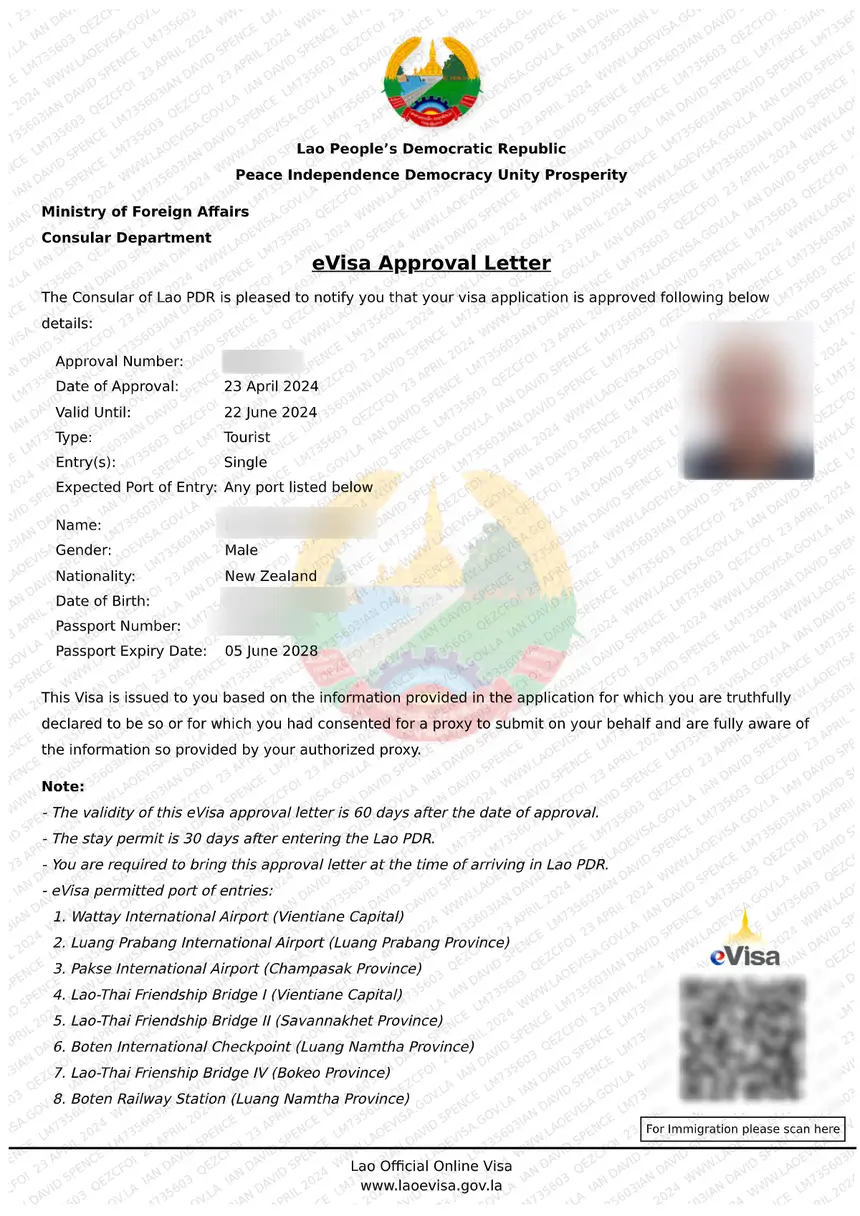
- Print and go – Bring a printed copy of your eVisa approval to show at immigration
- Special lane access – eVisa holders can use the dedicated eVisa lane at arrival ports, which is usually much shorter than the standard queue
- Tourist visa only – The eVisa is issued under the T-B3 (tourist) category. If you need a business visa or other category, you cannot use the eVisa system
The eVisa costs approximately $50 USD, which includes the government visa fee and a processing fee. Payment is made online by card at the time of application.
Who Can Apply for the Laos eVisa?
Nationals of most countries can apply for the Laos eVisa. However, a few nationalities are not eligible and must use the visa on arrival or embassy route instead. Check the official portal for the current eligibility list before applying.
What Is the Laos Visa on Arrival?
The Visa on Arrival (VOA) is the traditional way to get a Laos visa. You fill out a form at the airport or land border crossing, hand over your documents, pay in cash, and receive your visa stamp on the spot.
Here is how the VOA works:
- No pre-application needed – Just show up at the border with the required documents
- Cash payment – VOA fees must be paid in US dollars. The exact amount varies by nationality, typically ranging from $30 to $42 USD, plus a small processing fee
- Photos required – You need to bring one or two passport-sized photos (4×6 cm, color, white background). Some travelers report getting photos on the spot for an extra fee, but this adds hassle
- Application form – You fill out a paper form at the counter, which takes a few minutes
- Available everywhere – VOA is offered at all international airports (Wattay, Luang Prabang, Pakse) and all major land border crossings
The VOA is straightforward but can involve waiting in line, especially during peak travel periods when multiple flights arrive at the same time.
Cost Comparison: Which Is Cheaper?
This is where it gets interesting. At first glance, the VOA looks cheaper, but the real cost comparison is more nuanced.
eVisa Total Cost
The eVisa costs approximately $50 USD all-in. This includes the visa fee and processing fee. You pay online by card, so there are no surprise costs at the border.
Visa on Arrival Total Cost
The VOA fee varies by nationality:
| Nationality | VOA Fee (USD) |
|---|---|
| Most nationalities | $30-42 |
| Some nationalities (e.g., certain African/Asian countries) | $40-50 |
On top of the visa fee, you may also pay:
- Processing fee: ~$1-2 USD
- Photo fee: $2-5 USD if you do not bring your own photos
- Form fee: Sometimes a small “tip” is expected
When you add up the VOA fee plus these extras, the total cost is often very close to the eVisa. For many travelers, the difference is only a few dollars either way.
Bottom line: The VOA is slightly cheaper for most nationalities, but the price gap is small enough that convenience often matters more than cost.
Processing Time and Convenience
eVisa: Plan Ahead, Breeze Through
The eVisa requires you to apply 3-5 working days before your trip. This means you need to plan ahead. However, once you arrive in Laos, the process is fast:
- Walk to the eVisa counter
- Show your printed approval letter and passport
- Get your stamp and go
The whole thing takes about 5-10 minutes. The dedicated eVisa lane is almost always shorter than the VOA queue.
Visa on Arrival: No Planning, But Wait in Line
The VOA requires no advance preparation, which is great for spontaneous travelers. However, you should expect to spend 15-30 minutes at the border, and sometimes longer if:
- Multiple flights have just landed
- It is a busy holiday period
- There are issues with your photos or paperwork
- The cashier is slow processing payments
You also need to have exact cash in USD. If you only have Thai baht or other currencies, you may face unfavorable exchange rates at the border.
Entry Points and Special Lanes
Where Can You Use the eVisa?
The eVisa is accepted at:
- Wattay International Airport (Vientiane)
- Luang Prabang International Airport
- Pakse International Airport
- Selected land border crossings (including Friendship Bridge at Vientiane and several Thai-Laos crossings)
However, not all land border crossings accept the eVisa. If you are entering Laos via a smaller or less common border crossing, you may not be able to use your eVisa and will need to get a VOA instead.
Where Can You Get a Visa on Arrival?
The VOA is available at all international airports and all major land border crossings, including smaller crossings that do not support the eVisa system. This makes the VOA the more flexible option if you are entering Laos overland at a less common crossing.
Which Should You Choose?
The best option depends on your travel style:
Choose the eVisa If:
- You want to skip the long queue at the airport
- You prefer paying by card rather than carrying cash
- You are entering through a major airport or supported border crossing
- You want peace of mind knowing your visa is approved before you travel
- You are a tourist (T-B3 category only)
Choose Visa on Arrival If:
- You are entering Laos spontaneously or on short notice
- You are crossing at a border that does not support eVisa
- You need a visa category other than tourist (e.g., business)
- You prefer not to deal with online applications
- You already have USD cash and passport photos ready
The Verdict
For most tourists with a planned itinerary, the eVisa is the better choice. The small extra cost is worth skipping the queue and having your visa sorted before you arrive. The dedicated eVisa lane alone can save you 20-30 minutes at immigration, which is valuable after a long flight.
However, if you are backpacking through Southeast Asia and entering Laos spontaneously overland, the Visa on Arrival is perfectly fine and widely used by millions of travelers every year.
Frequently Asked Questions
Is the Laos eVisa cheaper than Visa on Arrival?
Not exactly. The eVisa costs about $50 USD, while the VOA costs $30-42 USD depending on nationality. However, the VOA often comes with small extra fees for photos and processing that bring the total close to the eVisa price. The difference is usually only a few dollars.
Can I get a Visa on Arrival at all Laos airports?
Yes. Visa on Arrival is available at all international airports in Laos, including Wattay (Vientiane), Luang Prabang, and Pakse. It is also available at all major land border crossings.
How long does the Laos eVisa take to process?
The eVisa typically takes 3-5 working days to process. Apply at least one week before your trip to be safe. You will receive your approval letter by email.
Do I need to print the eVisa approval?
Yes. You should print a copy of your eVisa approval letter and carry it with your passport. Digital copies on your phone may not be accepted at all immigration counters.
What if my eVisa application is rejected?
If your eVisa is rejected, you can still apply for a Visa on Arrival at the border, provided your nationality is eligible. Common reasons for eVisa rejection include incorrect passport details, poor quality photo, or incomplete application.
Can I extend an eVisa in Laos?
Yes. The 30-day eVisa can be extended once at the immigration office in Vientiane. The extension is typically for an additional 30 days and costs around $2 per day plus a small processing fee.
Is the eVisa available for all nationalities?
Most nationalities can apply for the Laos eVisa, but a few are excluded. Check the official portal at laoevisa.gov.la for the current eligibility list.
Do I need USD cash for the Visa on Arrival?
Yes. VOA fees must be paid in US dollars. Some border crossings accept Thai baht, but the exchange rate is usually unfavorable. Bring clean, crisp USD bills – torn or heavily marked notes may be rejected.